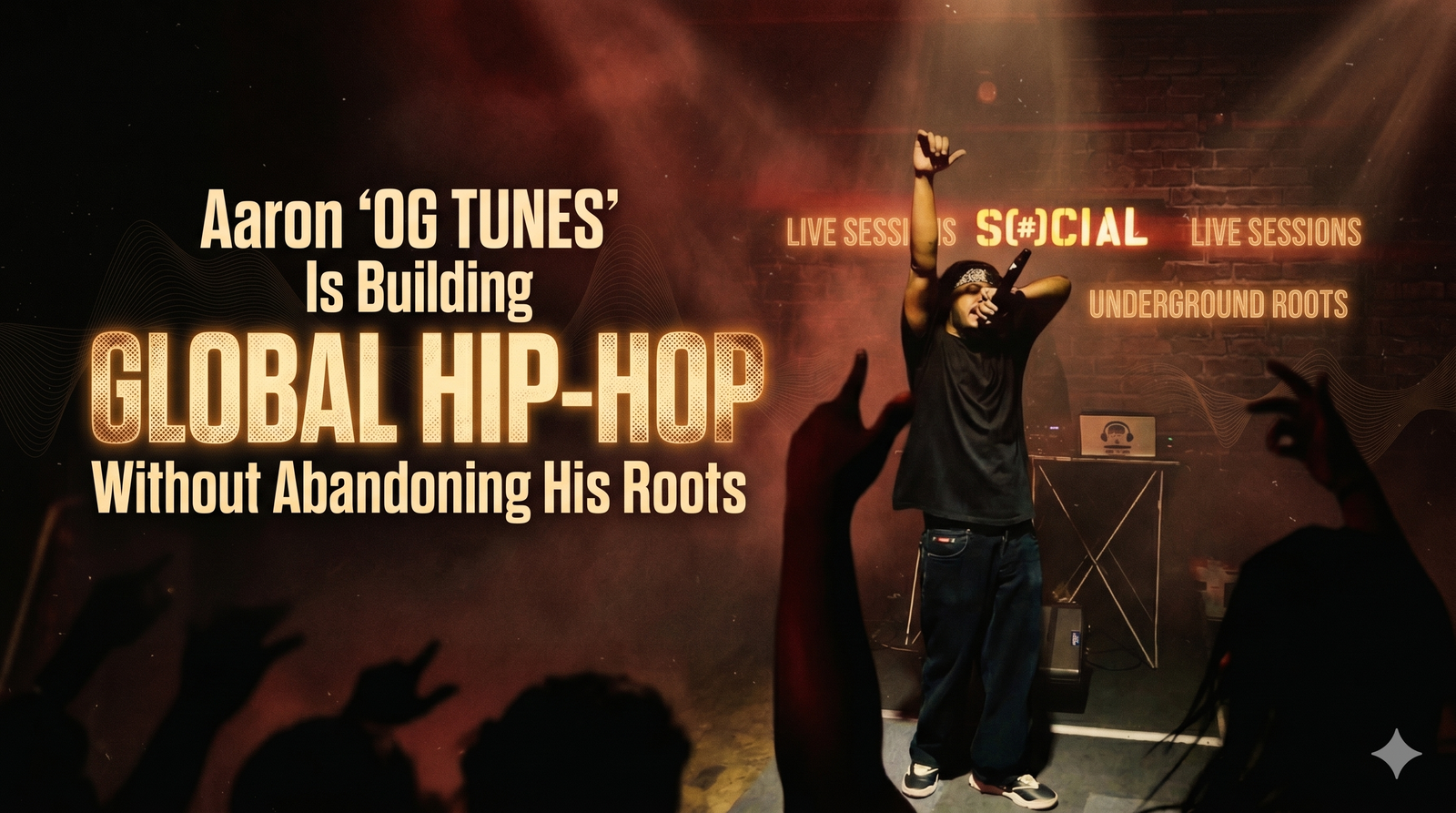
Aaron ‘OG TUNES’ Is Building Global Hip-Hop Without Abandoning His Roots
Some artists want to sound international.
Aaron ‘OG TUNES’ wants to sound borderless.
There’s a difference.
One is imitation. The other is synthesis.
And from the beginning, his music has been built around that second instinct — pulling together languages, cultures, energies, and influences that normally sit far apart from each other, then forcing them into the same sonic world without letting the identity collapse.
That ambition shows up immediately in his music.
Tamil. Hindi. English. Marathi. High-energy flows. Spiritual undertones. Street mentality mixed with global references. Indian textures sitting beside modern hip-hop structures.
It’s chaotic if handled poorly.
But when it works, it creates something much larger than genre.
Aaron’s relationship with music began before he understood it professionally. Long before studios, releases, or streaming platforms, he was already using words as weapons and expression as survival. As a student, he would write poems and diss tracks aimed at teachers he disliked, discovering early that rhythm and language gave him a strange kind of control.
But the real shift came later, when he picked up the guitar.
That changed everything.
Because once melodies entered the picture, expression stopped being limited to writing. He could now shape emotion sonically. Tunes became songs. Ideas became records. And slowly, what started as instinct became identity.
Like most independent artists entering hip-hop without infrastructure, the early phase was brutally practical.
No easy studio access. No production network. No reliable engineers. Even buying beats and getting songs mixed became obstacles. Before music becomes art, it often becomes logistics first, and Aaron had to build those connections manually while simultaneously learning how the scene itself operated.
That phase matters more than people think.
Because artists shaped under scarcity usually develop sharper creative adaptability. They learn how to move without waiting for perfect conditions.
And that mentality still runs through his work.
His influences explain why his sound feels unusually expansive.
There’s the revolutionary spirit of Bob Marley, the emotional realism and rebellion of Tupac Shakur, the technical aggression of Eminem, and the charisma-driven energy of Lil Wayne.
Those influences don’t naturally lead to one sound.
They lead to range.
And range is exactly what defines him.
What makes Aaron stand apart is not just multilingual rap on its own. Plenty of artists switch languages now. The real distinction is that every language shift in his music feels connected to energy rather than novelty.
His songs don’t move like calculated “fusion attempts.”
They move like someone genuinely shaped by multiple worlds at once.
That’s why the music often carries an international atmosphere without sounding disconnected from where he comes from.
Lyrically, his themes move between spirituality, motivation, politics, resilience, love, and personal power. But underneath all of them is one recurring idea:
movement.
His music rarely feels passive. Even when reflective, it pushes forward aggressively. The energy is intentional. He wants listeners to feel uplifted, alert, and emotionally charged by the time the track ends.
Not just entertained.
Activated.
That approach has already started creating notable moments in his journey.
Being recognized by late hip-hop icon DMX and legendary rapper Fat Joe gave his work an unusual kind of credibility early on, especially for an independent Indian rapper operating outside mainstream systems. Add to that performances across venues like Antisocial, Rasta Bombay, and Invincible in Mumbai, and it becomes clear that his music already carries a strong live dimension.
Which makes sense.
Artists driven by energy tend to scale best on stage.
But despite the momentum, the core challenge remains visibility.
Not creativity.
Not work ethic.
Marketing.
Like many independent artists creating ambitious music outside conventional industry formulas, Aaron is still fighting the gap between making impactful work and getting it consistently discovered by larger audiences.
And ironically, that challenge is intensified by how global his sound already feels.
People often assume he is from the United States before learning he’s based in Mumbai.
That misunderstanding says something important.
The music already travels further than the infrastructure around it.
His upcoming project BOMBAY BLOOD seems designed to push that identity even further. Blending new-wave hip-hop with Indian classical elements and classical dance influences, the project appears less interested in fitting into existing categories and more interested in creating a cinematic experience around cultural collision itself.
That’s a difficult path.
Because fusion only works when both sides remain authentic.
If one side becomes costume, the entire thing falls apart.
What makes Aaron ‘OG TUNES’ interesting right now is not just his versatility.
It’s the scale of his intent.
He is not trying to become “an Indian rapper with global appeal.” He seems far more interested in building a version of hip-hop where cultural boundaries stop mattering entirely.
That ambition can easily become messy, overextended, or performative.
But when it works, it creates artists that feel difficult to categorize.
And those are usually the ones people remember longest.
Community Talk.
Join the conversation
Login NowBe the first to comment!