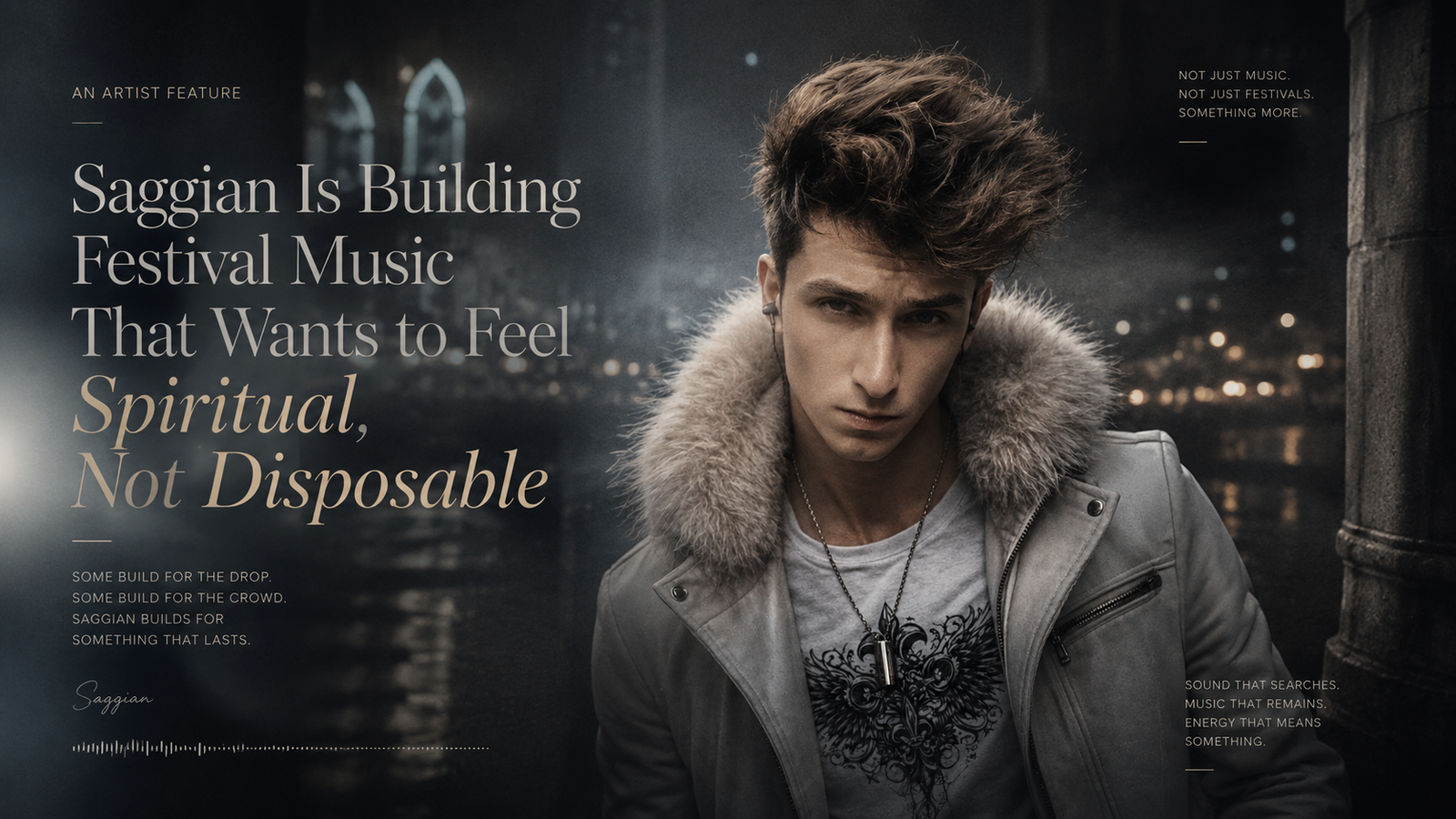
Saggian Is Building Festival Music That Wants to Feel Spiritual, Not Disposable
A lot of electronic music is designed for reaction.
The drop.
The lights.
The crowd moment.
The clip.
Saggian seems far more interested in something else entirely.
Connection.
Not in the vague, cliché way dance music often talks about “unity,” but in a more personal and almost philosophical sense. Beneath the festival-ready synths, melodic buildups, and progressive house structures, his work keeps circling back to a recurring idea: music as a force larger than entertainment itself.
Something emotional.
Something transformative.
Something almost supernatural.
And that perspective changes the way his entire catalog feels.
Long before he was releasing electronic music independently, Harsh Vardhan was already living inside sound.
He started playing drums around class 3 or 4 and spent most of his school years inside music rooms, moving between piano, guitar, and percussion while experimenting with melodies on old Nokia devices for friends. That early curiosity mattered because it built his relationship with music around instinct first, software second.
By the time many producers begin learning plugins and DAWs, he had already spent years understanding rhythm physically.
That foundation still shows in his work today.
Even when the production leans cinematic and high-energy, there’s usually a sense of movement underneath it that feels musician-led rather than machine-led.
Like many independent electronic artists from India’s earlier internet era, Saggian also entered production during a time when learning resources were nowhere near as accessible as they are now.
When he first started exploring FL Studio, tutorials were limited, structured learning paths barely existed, and most progress came through experimentation, failure, and repetition. That forced self-learning process became one of the defining aspects of his artistic mindset.
Not because struggle automatically creates better artists — it doesn’t.
But because figuring things out alone tends to develop stronger creative instincts.
You stop relying on formulas.
You start relying on ears.
His deeper shift toward EDM culture happened during college, when he discovered festival aftermovies from events like Tomorrowland and Electric Daisy Carnival. For a generation of producers, those videos became more than event recaps. They were emotional recruitment tools.
And for Saggian, they opened up an entirely new understanding of scale.
Artists like David Guetta, Avicii, and Afrojack helped shape his early sonic direction, but the influence went beyond sound design. It was about emotional architecture — the idea that electronic music could create collective emotional experiences powerful enough to feel almost cinematic.
That ambition still drives his work now.
But what separates Saggian from many producers working in melodic EDM spaces is his insistence on bringing cultural texture into that scale.
His music regularly blends ethnic instrumentation, emotional motifs, and Indian tonal influences into festival-oriented electronic structures without making the fusion feel forced or performative. Tracks like Temple of the Sun and The One They Spoke About carry the uplifting energy expected from progressive house and melodic mainstage music, but underneath them is a consistent search for atmosphere and meaning.
He doesn’t approach electronic music like pure escapism.
He approaches it like emotional world-building.
That becomes even clearer when looking at The Wand, his 12-track album built around melodic progression, emotional energy, and interconnected storytelling themes. Across his releases, there’s a recurring belief that songs are not isolated records but fragments of a larger evolving narrative.
Titles like Supernatural, Touch the Sky, Rhythm Love, and Temple of the Sun don’t just sound cinematic. They’re intentionally written to exist inside the same emotional universe.
That kind of continuity is rare in a genre often driven by singles and instant-impact releases.
At the same time, his journey has already started producing tangible momentum.
His collaboration SARGAM with Kaki Singer crossed over 65,000 streams, while The One They Spoke About surpassed 123K+ views. But the most striking breakthrough so far came through his remix work. His remix of Mwaki by Zerb accumulated more than 3.3 million views on YouTube — a scale that dramatically expanded his visibility as an independent producer.
Still, the more interesting milestone may actually be his involvement with the Tomorrowland Foundation’s EK Tara School initiative in Kolkata during 2025.
Because it reflects something important about the direction of his artistry.
He isn’t only chasing audience growth.
He’s trying to place his music inside experiences and communities larger than himself.
There’s also an unusual level of conviction in the way Saggian talks about music itself.
Most artists describe songs as self-expression.
He describes them more like manifestations.
To him, music is not merely created. It is channelled. A reflection of emotional and energetic shifts happening both internally and externally. That belief explains why his work often feels intentionally uplifting even when emotionally layered.
The goal is not just intensity.
The goal is elevation.
And maybe that’s ultimately what makes Saggian interesting at this stage of his journey.
Not the streams.
Not the drops.
Not even the festival aesthetic.
It’s the fact that he seems to view electronic music less as content and more as transmission.
In an era where EDM increasingly risks becoming disposable background energy for algorithms and short-form clips, Saggian is still chasing something immersive, emotional, and strangely spiritual.
And whether that vision scales massively or not, the intention behind it already feels distinct.
Community Talk.
Join the conversation
Login NowBe the first to comment!