Ishaan Nigam Is Trying to Make Comfort Sound Cinematic
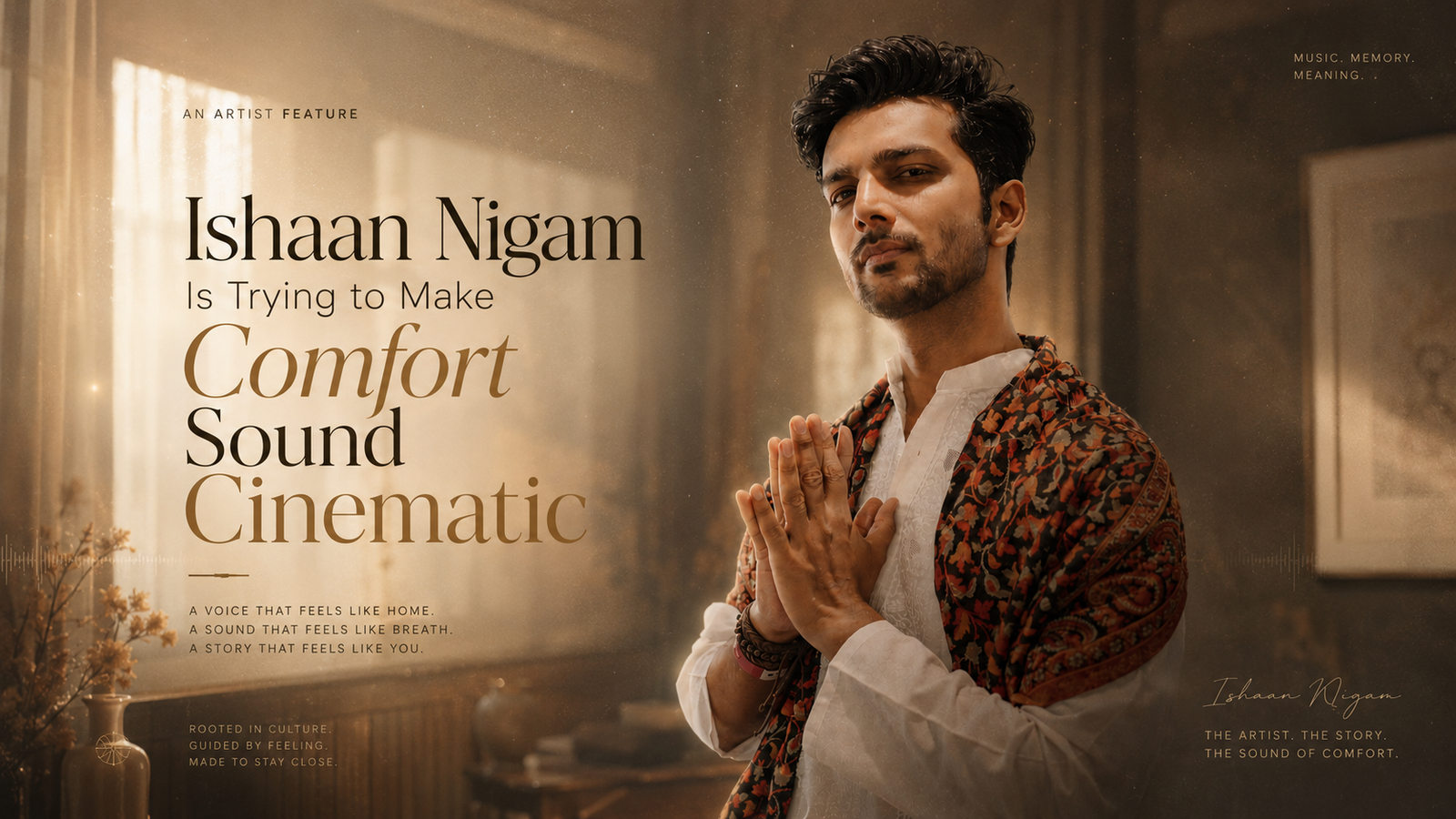
Some artists make music that demands attention.
Ishaan Nigam is trying to make music that stays beside you quietly.
That difference matters.
Because in a time where most releases are engineered for instant reaction, louder hooks, faster retention, bigger moments, Ishaan’s approach moves in the opposite direction. Softer. Slower. More atmospheric. Almost like he’s less interested in overwhelming the listener and more interested in understanding them.
His own description says it best.
He wants his songs to feel like a pillow. Something that supports emotion instead of interrupting it.
And honestly, that’s a far more difficult thing to pull off than people realize.
Growing up around classic Hindi film music, Ishaan’s relationship with melody began before it became technical. The radio became his first teacher. The songs stayed in his head long after they ended, and somewhere inside that repetition, music stopped becoming background noise and started becoming instinct.
But what makes his artistic direction interesting is not nostalgia alone.
It’s the conflict he carries while creating.
On one side, there’s the ambition to sound international. On the other, there’s the refusal to disconnect from Indian classical roots. Most artists solve that tension by choosing one side. Ishaan seems more interested in living inside the friction itself.
That’s where his sound begins to form.
The influences explain the duality clearly.
You can trace the emotional openness and melodic softness of artists like Enrique Iglesias, while also feeling the depth and discipline inherited from figures like Mohammed Rafi and Rashid Khan.
Those are very different worlds.
One is cinematic global pop. The other is rooted emotional tradition.
The challenge is not drawing inspiration from both.
The challenge is blending them without sounding confused.
And that is exactly the tightrope Ishaan appears to be walking.
His music sits in a space that can best be described as ambient pop touched by Indian classical emotion. Not classical music modernized for trend appeal, but classical influence softened into atmosphere.
That distinction is important.
Because he’s not trying to show technical mastery every second. He’s trying to create feeling.
The songs revolve around phases of love, fragments of hope, and emotional transitions that don’t always arrive dramatically. Sometimes they just sit quietly in the background of someone’s life until a lyric suddenly feels personal.
That emotional restraint gives his music its identity.
What also stands out is that Ishaan doesn’t talk like someone chasing virality.
He talks like someone building emotional utility.
He wants listeners to lean on the music.
That immediately changes the role the songs are supposed to play. They’re not built as performance pieces first. They’re built as emotional spaces.
And artists who create from that mindset usually grow slower, but deeper.
At the same time, the realities around independent music haven’t spared him either.
Discovery remains difficult. Live opportunities remain limited. Marketing budgets still shape visibility more than talent does. These are familiar problems across the independent ecosystem, but for softer, emotionally driven artists, the challenge becomes even harsher.
Because subtle music rarely explodes instantly.
It spreads through connection.
And connection takes time.
That’s why the upcoming debut EP Maheen Ishq feels important.
Not because it is his first large release, but because it appears to be the clearest articulation of his artistic world so far. The project is being rolled out gradually across three months, beginning April 21st, almost like he wants listeners to sit with each phase instead of consuming the work all at once.
That pacing says something about the music itself.
It isn’t trying to rush intimacy.
There’s also something quietly admirable about the way Ishaan frames his own journey.
He doesn’t present it as glamorous. He openly acknowledges coming from a place where access to music education and infrastructure wasn’t naturally available. Which means his path into music wasn’t inherited through systems. It had to be built manually, step by step, through persistence and self-direction.
And maybe that explains why his music feels less performative and more personal.
Because for him, music doesn’t seem to come from image first.
It comes from emotional necessity.
Right now, Ishaan Nigam exists in an interesting space.
Too rooted to become generic ambient pop. Too atmospheric to fit neatly into traditional playback expectations. Too emotionally restrained to force attention aggressively.
But sometimes that in-between space becomes the most lasting one.
Because listeners don’t always return to the loudest music.
They return to the music that understood them quietly when nothing else did.
Community Talk.
Join the conversation
Login NowBe the first to comment!