Kaumayy Is Turning Quiet Feelings Into Songs That Refuse to Leave
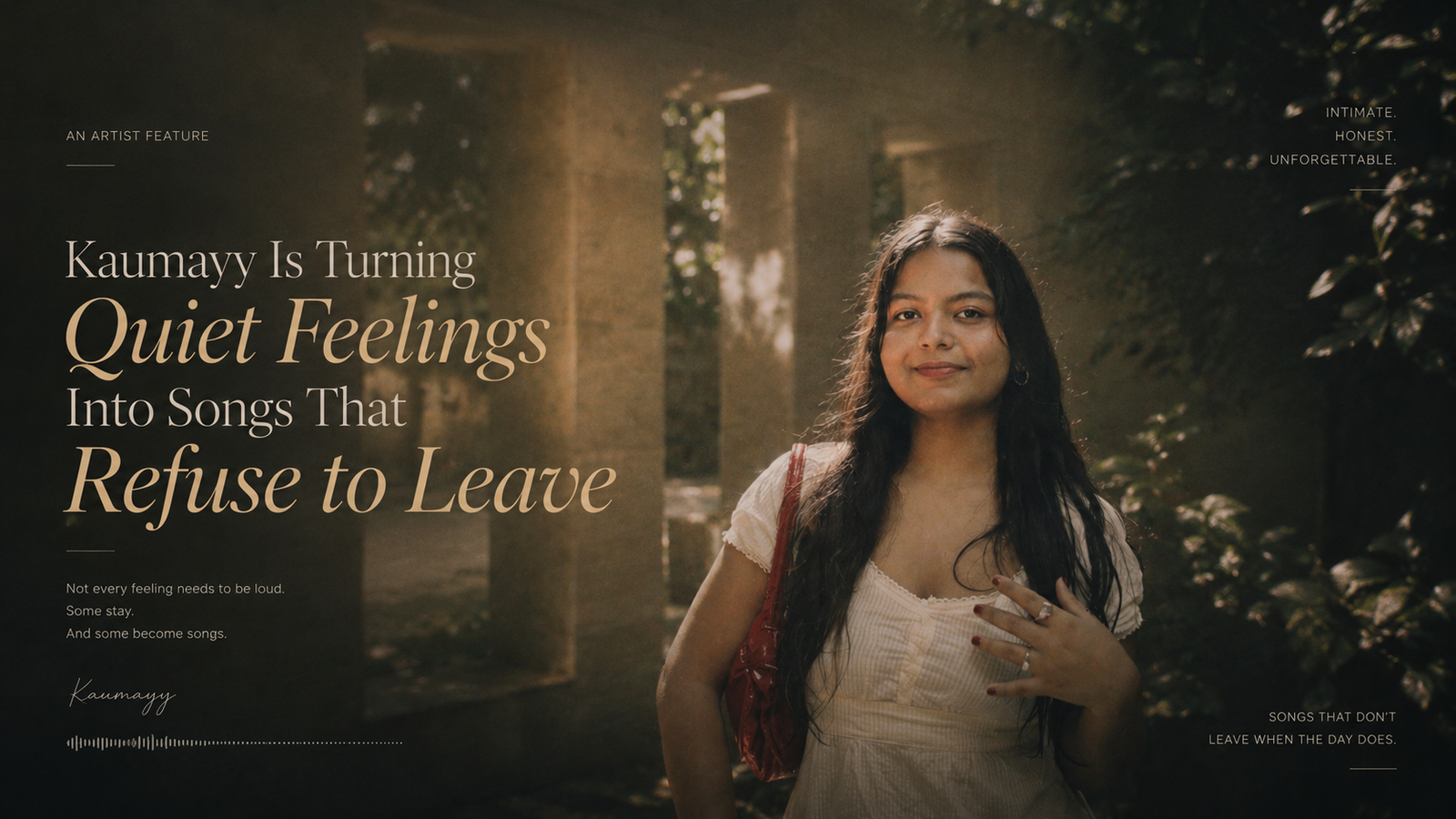
Some artists enter music through ambition.
Kaumayy entered through obsession.
Not industry obsession. Not fame. Something far more internet-era and strangely honest.
She wanted Harry Styles to notice her.
So she wrote him a birthday song and released it online.
That could have easily remained a fleeting fan moment, another temporary creative impulse buried somewhere in the internet archive. Instead, it accidentally became the beginning of an entirely different relationship with music. While trying to create something for someone else, she discovered that songwriting gave her a language for herself.
And that shift changed everything.
What makes Kaumayy’s story interesting is how unintentionally it began.
There was no grand declaration of becoming an artist. No calculated entry into the independent music scene. Even her early exposure to music came through ordinary transitions. Changing schools. Discovering music classes. Receiving a ukulele from her father after her 10th boards.
None of it sounds dramatic individually.
But creative identity rarely arrives dramatically in real life.
Most of the time, it builds quietly until one day it becomes impossible to ignore.
Her music now sits inside the world of indie bedroom pop, but emotionally it feels even smaller and more intimate than that label suggests. She gravitates toward the mundane corners of life most people overlook — exhaustion, grief, family tension, mental health, teenage sadness, emotional numbness.
Not the cinematic version of pain.
The ordinary version.
The kind that slowly accumulates in silence.
That emotional restraint is what gives her songwriting its weight. She doesn’t write like someone trying to impress listeners with complexity. She writes like someone documenting thoughts before they disappear.
And that honesty makes the songs linger longer than expected.
Tracks like Mom, I’m Tired and I’ll Be Alright don’t rely on loud emotional peaks. Instead, they move softly, almost cautiously, allowing listeners to project their own experiences into the spaces between the lyrics.
That approach explains why Mom, I’m Tired crossing 150,000 Spotify streams matters beyond numbers alone.
Songs this emotionally quiet usually grow through connection, not hype.
People don’t stream them because they’re trendy.
They stream them because they return to them privately.
At the same time, Kaumayy is still figuring out how to fully translate the world in her head into finished records.
And she admits that openly.
Writing comes naturally to her. Production doesn’t always. She often enters collaborations with a very specific emotional vision, only to watch it evolve into something unexpected once producers begin interpreting the song themselves.
That tension between imagination and execution is currently one of the defining struggles of her artistry.
But honestly, it’s also part of what makes her music feel alive.
Because the songs don’t sound overcontrolled. They still carry traces of uncertainty and experimentation inside them.
There’s also another layer shaping her current journey that can’t be ignored.
She’s balancing all of this while studying medicine.
And that changes the emotional texture of her music more than people might realize.
Medicine demands discipline, structure, and emotional endurance. Songwriting demands openness, vulnerability, and emotional release. Existing inside both worlds simultaneously creates a constant internal negotiation between pressure and expression.
That’s why her music never feels performatively sad.
It feels emotionally exhausted in a very real way.
Despite the deeply personal nature of her writing, Kaumayy doesn’t want listeners to treat her songs as isolated diary entries. What she actually wants is for people to see themselves inside them. To use the music as a mirror rather than simply observing her story from a distance.
That distinction matters.
Because her songs are not asking for sympathy.
They are creating space for recognition.
She was also nominated for Best Debut Artist at the TIMD Awards 2022, a recognition that quietly signaled how strongly her early work was already resonating within independent spaces. But the more interesting part of her trajectory is not the milestone itself.
It’s the fact that she still sounds unfinished.
And that’s a compliment.
There’s still visible room for evolution in her production, her sonic confidence, and the scale of her artistic identity. But the emotional core already exists. The honesty is already there. And artists can learn technique much faster than they can learn sincerity.
What makes Kaumayy compelling right now is not perfection.
It’s emotional residue.
Her songs don’t try to dominate attention. They simply stay behind after everything else gets quiet.
And in a music culture becoming increasingly louder, faster, and more algorithmic, that kind of softness can become unexpectedly powerful.
Community Talk.
Join the conversation
Login NowBe the first to comment!