Saranssh: Why Simplicity Is Earned, Not Written
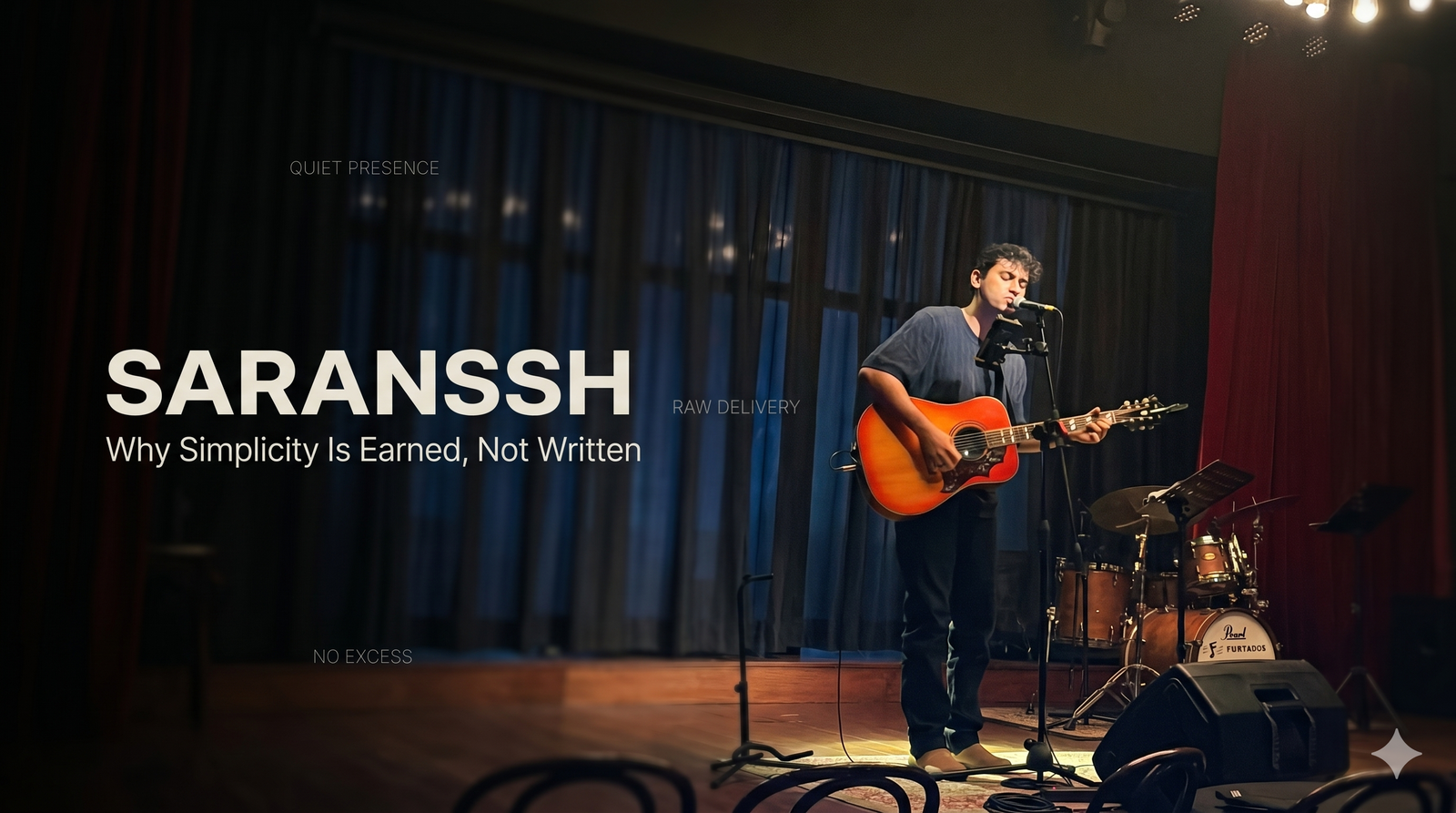
Some artists spend years trying to sound like something.
Very few spend years trying to understand why they shouldn’t.
Saranssh belongs to the second kind.
Based in Delhi, his relationship with music didn’t begin with a sudden realization or a defining moment. It began quietly, almost structurally. At the age of four, he was already learning Hindustani classical music, absorbing discipline long before he understood what expression really meant. Back then, music wasn’t a decision. It was just something he was placed into.
The guitar came later, and in a way that feels almost too casual for what it eventually became. His friends wanted to learn, and he didn’t want to be left out. So he picked it up too. What started as a social decision slowly turned into something much deeper, something that stayed long after the initial curiosity faded.
And then came the phase most artists don’t talk about honestly.
The phase of rushing.
Wanting to be good before you’ve earned it. Trying to replicate the people you admire without understanding the time and repetition behind their sound. For years, Saranssh found himself caught in that loop, measuring himself against standards he hadn’t yet lived through.
Eventually, something shifted. Not in his ability, but in his perspective.
He stopped trying to get there quickly.
And started staying where he was.
That shift doesn’t show up loudly, but it changes everything that follows. Because once you stop rushing, you begin to notice things differently. You listen more closely. You write more honestly. You stop forcing complexity and start trusting simplicity.
That’s where his music begins to take shape.
There’s a certain ease in the way his songs unfold, but it’s not accidental. It comes from years of sitting with the instrument, understanding not just how to play, but when not to. The influence of artists like John Mayer can be felt here, not in imitation, but in restraint. The ability to let a song breathe without trying to prove anything.
His writing moves in a similar way. He doesn’t try to obscure emotion or dress it up in heavy language. The themes he explores are familiar, sometimes almost too familiar at first glance. Inner conflict, hope, the quiet effort of breaking out of patterns that hold you back. But the way he approaches them feels grounded, almost conversational, as if the song isn’t performing for you, but sitting with you.
That sense of familiarity is not a shortcut. It’s a decision.
Because writing simply is harder than it looks. It requires clarity, and clarity usually comes after confusion, not before it.
Over the years, that clarity has been tested in front of real audiences. More than 400 live shows have shaped not just his performance, but his understanding of what actually connects. There’s a difference between thinking something will work and watching it land in a room full of people. That kind of repetition builds a quiet confidence, the kind that doesn’t need to announce itself.
And now, that same connection is beginning to extend beyond the stage. Recent releases have started to find their audience, growing steadily rather than explosively. It’s not the kind of growth that grabs attention overnight, but it’s the kind that holds.
His recognition as the winner of the Rise Del x Fresh Lime Studios singer-songwriter competition sits somewhere in the background of all this. Not as a turning point, but as a marker. A sign that the years of staying with the process are beginning to reflect outward.
But like most independent artists at this stage, the real challenge isn’t making the music.
It’s everything around it.
Balancing performances, writing, production, visibility, and the constant demand to be present everywhere at once. It’s a system that often pulls artists away from the very thing they started with. And learning to navigate that without losing the core of what you do is not simple.
Still, there’s a sense that Saranssh isn’t trying to chase anything outside of the work itself.
He’s not trying to reinvent the genre. He’s not trying to create something that stands apart just for the sake of it. If anything, he’s doing the opposite. He’s leaning into what’s already human, already shared, and finding his place inside that.
What he wants from a listener is not complicated.
To feel like the song understands them.
To find a small part of themselves in it.
To sit with it for a while longer than expected.
And maybe that’s why his music feels the way it does.
Because it isn’t trying to arrive somewhere.
It’s trying to stay.
And sometimes, that’s the harder thing to do.
Community Talk.
Join the conversation
Login NowBe the first to comment!